
Cumberland Court Records After Arrest
A Cumberland County jail arrest and a Cumberland County court case are connected, but they are not the same record. The jail booking record is created when the person is searched, screened, identified, photographed, fingerprinted, checked for warrants, and entered into the detention system. The court record begins when charges are filed and tracked through the North Carolina Judicial Branch. The Cumberland County Clerk of Superior Court controls court files, while Prosecutorial District 14 handles prosecution for the State.
The sheriff's Court Appearances and Case Lookup page says inmates may have court appearances in the jail courtroom, at the Cumberland County Courthouse, or in other courtrooms depending on charge and jurisdiction. Movement times are not announced, and visits are not available during those movements. For custody and booking status, use Cumberland County jail inmate records. For booking photos and recent arrest photo limits, use Cumberland County jail mugshots. Court records after an arrest focus on filed charges, status, hearings, and disposition.
Search Court Records After Arrest
The North Carolina Judicial Branch says criminal case information can be searched at a public self-service terminal in a clerk of court's office in any county. Search options include defendant name, case number, and victim or witness name. The Judicial Branch also points users to the online Portal for case information, while background-check users are directed to the county clerk's office rather than relying only on Portal results.
The North Carolina eCourts Portal is the online case-search channel for counties using eCourts.
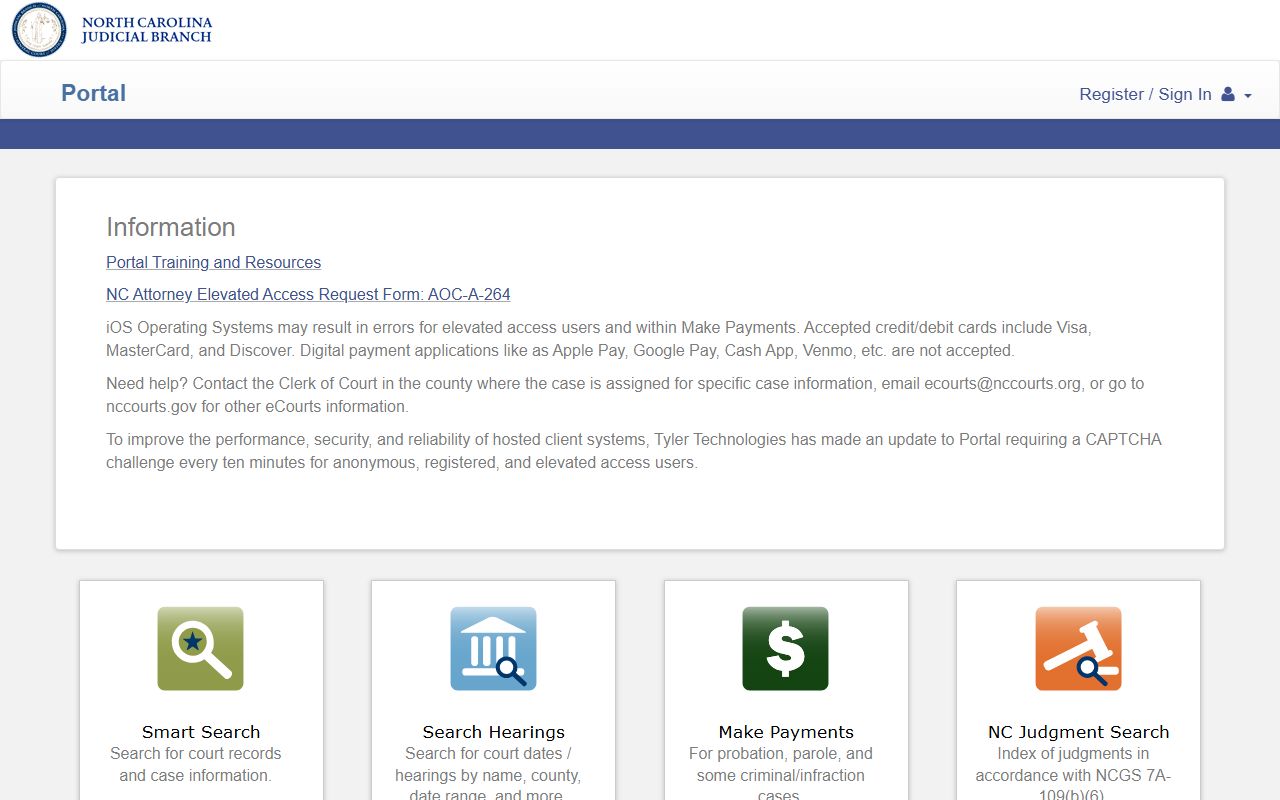
The portal helps locate case information, but paper files and certified copies still route through the clerk's office where the case is filed.
| Field Label | Type | Required | Options / Format Notes |
|---|---|---|---|
| Defendant Name | Search field at public terminal / Portal | Unspecified | Use the full legal name when possible. |
| Case Number | Search field | Optional if known | Best for an exact case. Format comes from the court filing. |
| Victim or Witness Name | Public terminal search option | Optional | Listed by Judicial Branch for terminal searches. |
| County / Location | Portal filter | Likely available | Select Cumberland County where the filter is offered. |
| Party / Attorney / Citation / Business search | Portal options | Dynamic | Confirm available options in the live eCourts interface. |
Cumberland Arrest to Court Record
The arrest-to-court path has several points where a search result may change. An arresting agency may process reports before jail commitment. The Cumberland County Detention Center then completes intake, sets up the jail record, and has bail determined by a judicial official. The first appearance may occur in the jail courtroom or courthouse. After that, the District Attorney reviews the case and decides how the criminal charges proceed in court.
- Arresting agency processes the arrest and prepares reports before or during jail commitment.
- Cumberland County Detention Center intake creates the booking record, with search, photo, fingerprints, screening, warrant checks, bail, and court-date entry.
- The first court appearance occurs at the jail courtroom, courthouse, or another courtroom tied to the charge.
- The prosecutor reviews the matter and files, amends, dismisses, reduces, or pursues charges through the court record.
- If the person is sentenced to state prison, custody information moves to NCDAC while the case remains a court record.
Cumberland Court Charges Filed
Prosecutorial District 14 serves Cumberland County. The District Attorney listed in the research file is Billy West, also identified as William West. The DA page says the district attorney represents the State, prosecutes all criminal cases filed in the district, represents the State in criminal and some juvenile matters, prepares the criminal trial docket, and advises law-enforcement officers. That role is the bridge between a jail arrest and formal court records after the arrest.
Booking charges can be rougher and earlier than court charges. The jail side records why a person was booked and what initial allegations or warrants were tied to custody. The court side shows the charge that the prosecutor files or pursues, later amendments, reductions, indictments, dismissals, pleas, trial outcomes, and sentencing. A person can appear in custody records before the court file is easy to find, especially if intake and court processing are still underway.
Prosecutorial District 14
Cumberland County Courthouse
117 Dick Street, Suite 427
Fayetteville, NC 28301
(910) 475-3010
Court Charging Documents
Charging documents are the papers that move an allegation into a formal court case. The research file frames the issue through the prosecutor's role and the court-file path, rather than a county-specific form list. For Cumberland County court records after arrest, the practical question is whether the charge appears as an initial complaint, a prosecutor-filed document, or a grand-jury indictment. The label affects how the charge entered court and who acted before it appeared in the case record.
| Document | Common Source | What It Does | Search Tip |
|---|---|---|---|
| Complaint | Law enforcement or prosecutor | States the alleged offense and begins or supports the criminal case. | Search by defendant name or case number after the filing reaches the court record. |
| Information | Prosecutor | Formal prosecutor-filed charge document used where allowed by procedure. | Compare it with jail booking charges because wording or counts may differ. |
| Indictment | Grand jury | Formal charge returned by a grand jury, often in felony prosecution. | Check later case entries if the first record started before indictment. |
Cumberland Charge Status Records
Charge status is the main reason court records after an arrest matter more than the booking entry. A jail roster may show the arrest-facing allegation, but the court case shows whether the charge is pending, amended, dismissed, reduced, resolved by plea, resolved after trial, or moved into a sentence. Status terms should be read charge by charge. One case can contain several counts with different outcomes.
| Status | What It Means | Why It Matters |
|---|---|---|
| Pending | The charge is still open in court. | Future hearings, bond conditions, or case settings may still apply. |
| Amended | The filed charge changed after review or court action. | The court record may differ from the jail booking language. |
| Reduced | The case moved to a lesser charge or lower level. | Disposition and sentencing exposure can change. |
| Dismissed | The charge was not pursued or was terminated by court action. | Dismissal is not the same thing as automatic expunction. |
| Convicted | The person was found guilty or entered a guilty plea. | The result becomes a conviction record unless later relief applies. |
Bond Records After Arrest
North Carolina pretrial release is governed by G.S. 15A-534. A judicial official must impose at least one listed release condition, such as an unsecured appearance bond, custody of a designated person or organization, a secured appearance bond by cash deposit, mortgage, or surety, or house arrest with electronic monitoring. The Cumberland County jail page says bail is determined by a judicial official during booking and a court date is set.
Bond information can sit in both worlds. The jail may know current custody and release status, while the court record may show orders and conditions tied to the case. Most inmates are eligible for bail and have phone access to contact family, friends, or bail agents, according to the sheriff. Holds from another jurisdiction, probation, DOC, ICE, or another lawful agency can delay release even when a local charge has a bond.
- Secured bond
- A bond backed by cash, property, or surety.
- Unsecured bond
- A promise to appear, with money owed only if the person fails to appear.
- House arrest with electronic monitoring
- A listed North Carolina pretrial release condition.
- Hold or detainer
- A request or legal basis for another agency to keep or receive custody.
Warrants and Court Arrest Records
The Cumberland County Sheriff's Office has a Fugitive/Warrants Section, but the research did not locate an official public warrant-search form on the sheriff site. The warrants page describes the unit's work: apprehension, extradition, entry of warrants and orders for arrest into local systems, and entry of felony and serious misdemeanor warrants or orders into DCI or NCIC. It also handles returns of wanted fugitives to Cumberland County for adjudication of felony charges.
Because there is no verified public warrant roster, the safer route is to check court records by defendant name or case number, use clerk channels, and contact counsel or the issuing agency when active-warrant risk is possible. Fayetteville P2C recent arrests may show a reason such as warrant or order for arrest after the person is arrested, but it does not replace the court file or the sheriff's official records. Public-record requests may help with nonconfidential arrest information, while investigation material may be limited by G.S. 132-1.4.
Note: Warrant status can lead to arrest, so legal advice should come from an attorney, not from a public search result.
Cumberland Charges vs Convictions
An arrest or charge is not a conviction. Fayetteville Police P2C includes an innocence disclaimer on recent-arrest entries, and the same principle applies to court records after an arrest. A charge means the State is accusing a person of an offense. A conviction means the case reached a guilty plea, guilty verdict, or other conviction outcome. Court records should be checked for the final disposition before any conclusion is drawn.
| Issue | Charge | Conviction |
|---|---|---|
| Stage | Accusation filed or tracked in the court case. | Final or entered finding of guilt. |
| Timing | Can appear soon after arrest or prosecutor review. | Appears only after plea, trial, or other conviction event. |
| Meaning | Does not prove guilt. | Reflects a formal case outcome unless later changed. |
| Where to verify | eCourts, public terminal, clerk file. | eCourts, public terminal, clerk file, and certified copies when needed. |
Sealed or Expunged Records
North Carolina public-records law, including G.S. 132-1 and G.S. 132-1.4, makes many public records available while also limiting criminal investigation and intelligence records. G.S. 15A-146 addresses expunction of records when charges are dismissed or there are findings of not guilty. A dismissal does not always mean every public mention vanishes automatically. Expunction is a court process, and the effect depends on the order and the agency records covered by it.
| Issue | Sealed | Expunged |
|---|---|---|
| Public visibility | Hidden or restricted from ordinary public access under a court rule or order. | Cleared under an expunction order for eligible records. |
| Common trigger | Confidential case type, protective order, juvenile or other restricted matter. | Dismissed charge, not-guilty finding, or other eligibility under state law. |
| Agency records | May remain available to specific authorized users. | Agencies may need the order before changing affected records. |
| Reader caution | Do not infer that a missing public record means no case existed. | Do not assume dismissal alone erased every record. |
Cumberland Court Record Copies
The N.C. Judicial Branch says paper court files can be accessed at the clerk's office in the county where the case is located, and copies can be made for a fee. Public self-service terminals at clerk offices can search criminal case information by defendant name, case number, and victim or witness name. For Cumberland County cases, the county location page and contact directory are the court routing sources, while the DA office is not the clerk's copy counter.
North Carolina G.S. 132-6.2 governs public-record copy fees in general, with ordinary uncertified copies generally limited to actual reproduction cost unless a special service charge applies. Court-copy rules and certified-copy fees should be verified with the clerk because court files follow Judicial Branch procedures. Police reports, jail booking records, and court files each have separate offices, even when they all stem from the same arrest.
Important: Court records can be incomplete online; verify dispositions and copies through the clerk when accuracy matters.